Law and safety · Tip 11 / 12
Protecting your image and privacy online – a guide for influencers
The more recognisable you become, the more important it is to protect what stays just for you. We've gathered practical ways to secure your accounts, your privacy and your image, plus tips on what to do when someone crosses the line.
- protecting your image online
- image rights
- Instagram account security
- GDPR for influencers
- social media privacy
- image rights infringement
01Why protecting your image online matters for you too
Protecting your image online is often associated with celebrities and big campaigns, but in practice it concerns anyone who regularly posts photos and videos of themselves. Your face, voice and style are now part of your work. They build recognition, attract brands and create a relationship with your followers. That's why it's worth treating them with the same care as your equipment, your bank account or your documents.
The good news is that many risks can be reduced with simple habits. The point isn't to be afraid of the internet, but to decide consciously what you show and when. This article is general in nature and doesn't constitute legal advice – for a specific case, it's worth contacting a lawyer.
02Account security – the foundation of peace of mind
Having your account hacked is one of the most stressful scenarios for a creator. You lose access to your community, and someone else can post in your name. Most account takeovers start with a weak password, a data leak from another service or a fake message impersonating a platform or a brand.
A few rules worth putting in place straight away:
- Turn on two-factor authentication on every platform, ideally via an authenticator app rather than SMS alone.
- Use a password manager and a separate, long password for every service.
- Set up a separate email address just for your social media accounts and don't share it publicly.
- Don't click links in messages about alleged copyright infringement or account verification – check notifications directly in the app.
- Regularly review the list of devices logged in and apps with access to your account.
- If you work with a manager or agency, grant access through account management tools rather than handing over your password.
03Location and private information
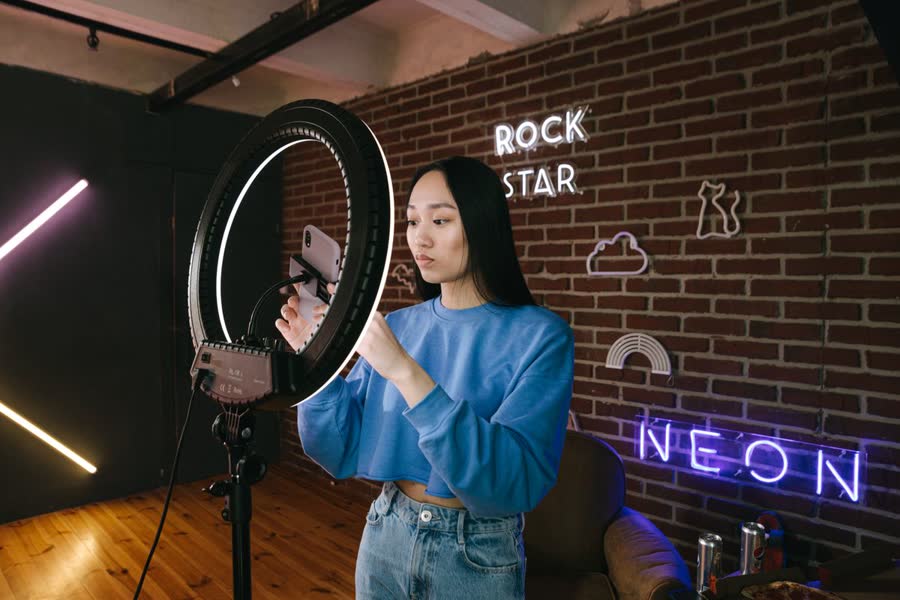
Even if you never share your address, followers can work out a lot from small details: the view from your window, a distinctive stairwell, a tram number or the café you go to every day. It's worth looking at your posts through a stranger's eyes and asking yourself what could be pieced together from them.
A good habit is posting Stories with a delay. You show breakfast at your favourite spot, but only after you've left. You share photos from a trip once you're home, or at least once you've moved on. Also switch off automatic location tagging on your photos and check your phone's camera settings.
Shooting in a studio or a hired location is another way to separate your private space from your content. Your home doesn't have to be a permanent set, and your followers don't need to know where you live to feel connected to you.
04Image rights and consent to publish
Under Polish law, a person's image is protected by, among other provisions, Article 81 of the Act on Copyright and Related Rights. As a rule, distributing someone's image requires the consent of the person shown. There are exceptions – for example, when someone is merely a detail of a larger whole, such as a crowd at a concert, or when a person was paid to pose and didn't stipulate otherwise. Your image is also a personal interest protected by the Polish Civil Code.
This principle works both ways. You decide where your face appears, but you also need to remember the consent of other people who feature in your content. A friend in a Reel, a partner in a Story, a model at a shoot – it's worth asking each of them a simple question: are they happy for it to be published? For commercial collaborations, it's better to have that consent in writing, specifying where and for how long the material will be used.
Take particular care with content showing children. Even if you have a parent's consent, consider whether the post is in the interest of the child, who will one day grow up and have their own view on it.
05GDPR in a creator's work
When you run a business, collect newsletter sign-ups, organise giveaways or store customer details, you're processing personal data. That includes spreadsheets of postal addresses for sending prizes and contact lists from agencies. RODO – the Polish name for the GDPR – requires you to do this for a specific purpose, securely and transparently for the people whose data it is. In practice, that means, among other things, preparing a privacy notice, collecting only the information you need and not sending it to anyone who shouldn't have it.
For giveaways, publish clear terms and state who the data controller is. Only post screenshots of your followers' private messages with their consent, or after blurring any details that could identify them. Once the giveaway is over, delete data you no longer need, and don't pass it on to a brand without a legal basis and the participants' knowledge.
06Privacy boundaries in your everyday content
Protecting your privacy isn't just about settings and regulations – it's also about the decisions you make every day when planning your posts. It's worth sitting down once and writing out what you never show, and what you only show to a limited extent. For one person that might be their partner's face; for another, their bedroom, family holidays or a car with a visible number plate. A list like this works as a filter: before posting anything, you check whether it breaks your own rules.
Remember, too, that the internet has a long memory. A deleted post may have been saved, and a Story recorded by someone else. Before you publish something very personal, ask yourself whether you'd feel comfortable with it in a few years' time – during a conversation with a new brand or employer, for example. This isn't about self-censorship; it's about making a conscious choice.
For lingerie, beauty or fashion shoots, it's especially important that all arrangements about publishing the material are clear before shooting begins. You have the right to know which shots will go online and to have a say in the final selection.
07What to do when someone misuses your image
Stolen photos, fake accounts, edited images and content published without consent happen more often than we'd like. The most important thing is to act calmly and methodically, rather than responding emotionally in the comments.
Legal remedies depend on the specific situation, so for more serious violations, contact a lawyer. Don't face it alone – someone close to you, your team or a professional can take some of the weight off you at a difficult time.
- Secure the evidence: dated screenshots, links and profile names.
- Report the violation directly to the platform, using its forms for impersonation or privacy violations.
- Let your followers know about a fake account if it could mislead anyone.
- If threats, blackmail or the publication of intimate material are involved, report it to the police.
Checklist to save
Tick off the points. Your progress is saved in this browser.
Frequently asked questions
Can I post a photo where other people are visible by chance?
If they're merely a detail of a larger whole, such as a crowd, Polish law provides an exception to the consent requirement. If someone is clearly recognisable and a significant part of the shot, it's better to ask for their consent. This is general information, not legal advice.
What should I do if someone has set up an account using my photos?
Secure the evidence, report the profile to the platform as impersonation and ask your followers to report it too. If the account is being used for scams or blackmail, consider reporting it to the police.
As an influencer, do I have to comply with GDPR?
If you collect personal data – for example through giveaways, a newsletter or your business – the rules of RODO (GDPR) apply to you. It's worth discussing the details with a specialist.
Hollyfuns Studio · Łódź
Do it with the Hollyfuns crew
Want to create cinematic content without showing your flat? Get in touch – our studio at ul. Gdańska 17 in Łódź gives you a space to work, while your private life stays private.
Series: 12 tips for influencers
Keep reading
 10
10Law and safety · 5 min read
Brand contracts and influencer ad disclosure – a guide for creators
Influencer ad disclosure made simple: what a brand contract should include and how to label sponsored posts under Poland's UOKiK guidelines. Practical guide.
Read the guide 12
12Law and safety · 5 min read
Influencer mental health – looking after yourself online and off
Influencer mental health: how to deal with online hate, pressure and comparison, set boundaries, take breaks and know when to seek a psychologist's support.
Read the guide 01
01Strategy and content · 5 min read
How to Choose Your Niche: An Influencer's One Sentence About Herself
How to choose your niche as an influencer: find what you could talk about for years, who's listening, and sum it up in one memorable Instagram bio line.
Read the guide